A 20% reduction and a 20% increase – why doesn't the price return to the starting point?
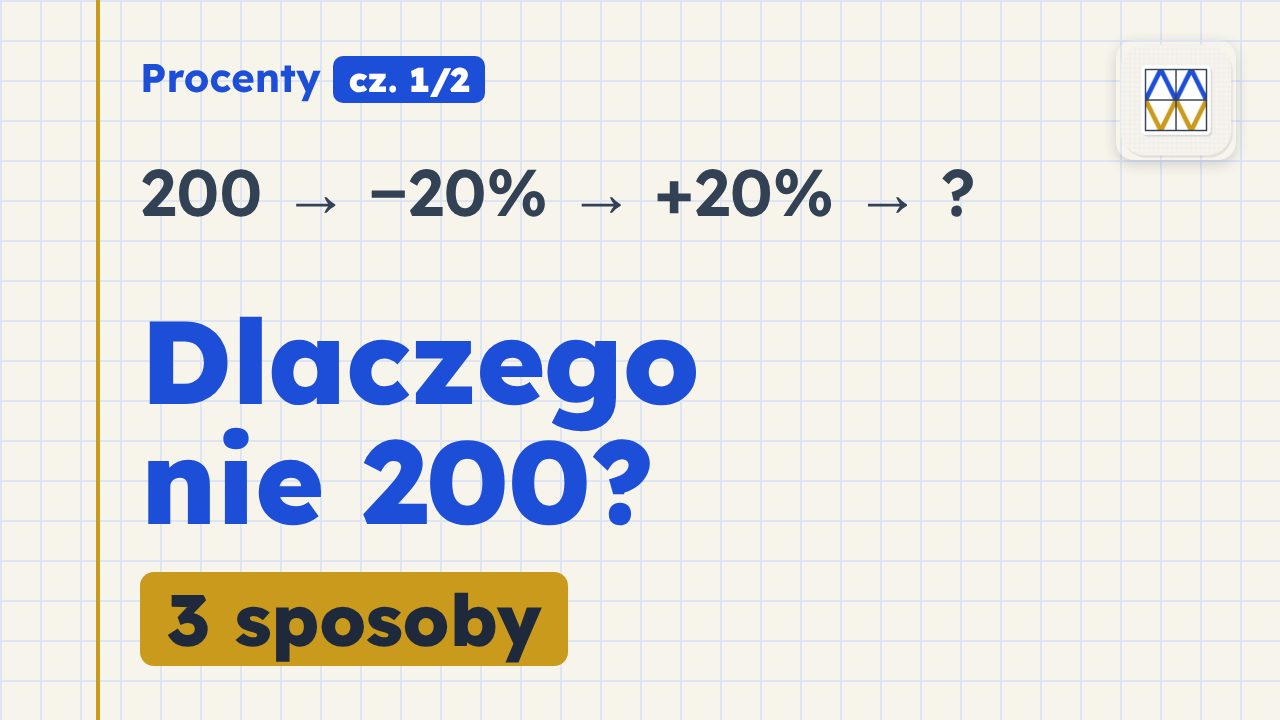
A jacket that cost 200, after a 20% reduction and a 20% increase, costs 192. Three ways of calculating: one percent, squares for the price of 100, and multipliers.
The lesson and video are in Polish. This is a translation of the description and lesson text for parents and students; Polish terms are given in brackets.
After you click, the video loads from YouTube (Google). The lesson is in Polish.
Lesson outline
Ways to the same result
One percent
First we check how much 1% of the price is, then we multiply by the number of percentages. We calculate the increase from the new price.
1% of 200 = 2, 20% = 40, 200 − 40 = 160; 1% of 160 = 1,6, 20% = 32, 160 + 32 = 192
Squares for the price of 100
We divide the price of 100 into 100 squares. After the reduction, 80 are left. We divide these 80 into 100 new squares – each is smaller (0,8), so 20 new squares are only 16.
100 → 80 → 96, which means 96% of the price is left; 96% of 200 = 192
Multipliers
A 20% reduction is multiplying by 0,8, a 20% increase is multiplying by 1,2.
200 · 0,8 · 1,2 = 200 · 0,96 = 192
The most common mistake
Calculating the increase from the old price (200) instead of the new one (160). Then you get 200, and the price actually fell by 4%.
Your turn
A jacket costs 200. The shop reduces the price by 50%, and then raises it by 50%. How much does the jacket cost in the end?
Show the answer
150. 50% of 200 = 100, 100 is left; 50% of 100 = 50, 100 + 50 = 150.
Download the worksheet (PDF, in Polish, with answers)
Lesson transcript
The lesson is recorded in Polish. Below is a translation of the lesson text; Polish terms are given in brackets.
Show the full lesson text
Introduction
A jacket costs 200. The shop reduces its price by 20%, and a week later raises it by 20%. How much does it cost now? Most people answer immediately: the same, 200. After all, a reduction and an increase by the same amount should cancel each other out. But the jacket costs 192. In this lesson you will see why this is the case, and step by step you will learn how to calculate it. On the screen you see the lesson plan and the minute when each part starts. First, percentage on an apple and a chocolate bar, then calculating on the prices of 100 and 200, and at the end a quick way with multipliers.
Percentage on an apple and a chocolate bar
Percentage means per 100. 1% is 1/100 of the whole. First, an apple. A whole apple is 100%. We cut it in half. Each half is 50%, which is 1/2 of the apple. Now we cut one half in half again. Such a piece is a quarter, which is 1/4 of the apple. That is 25%. Now a bar of chocolate. It has 10 squares, in 2 rows of 5. The whole bar is 100%. One row, which is 5 squares, is 50%. One square is 1/10 of the bar, which is 10%. 2 squares are 20%. The percentage tells us what part of the whole we are taking. Pause the video and say: what percentage of the bar are four squares? In a moment I will show the answer. 4 squares is 40%, because each square is 10%.
Calculating on the price of 100
Now the price. Let's take the price of 100 and divide it into 100 equal squares, like in a notebook. One square is 1%. 1% of 100 is one. A reduction of 20% takes away 20 squares, which is 20. 80 squares are left, which is 80. This is the most important part of the lesson. A 20% increase is calculated from the new price, not the old one. From 80, not from 100. The new price is a new whole, which is a new 100%. We divide 80 into 100 squares. Each square is now smaller. One square is now 0,8. 20 such squares is 16, not 20. 80 + 16 gives 96. The reduction took away 20, and the increase gave back only 16, because it was calculated from a smaller price.
The same on the price of 200
Now let's return to the jacket for 200. Before I show it, pause the video and calculate: how much is 1% of 200? One square is 2, so a 20% reduction takes away 40. 160 is left. We calculate the increase from 160. One square is 1,6, and 20 squares is 32. Each time we calculate the same way. First we check how much 1% is, and then we multiply by the number of percentages. 160 + 32 gives 192. In both examples the price fell by 4%. That is no coincidence.
A quick way: multipliers
Now a way that speeds up calculating. After a 20% reduction, 80% of the price is left, which is 0,8. A 20% increase is 120% of the price, which is 1,2. Such numbers are called multipliers. Pause the video and choose: what is the multiplier for a 30% reduction? A: 0,3. B: 0,7. C: 1,3. The correct answer is B, 0,7, because after a 30% reduction 70% of the price is left. We return to the jacket. 200 · 0,8 · 1,2. 0,8 · 1,2 is 0,96. That means 96% of the price is left. The price fell by 4%, regardless of how much the jacket cost at the beginning.
Your turn
Your turn. The same jacket for 200, but the reduction and increase are by 50%. How much does it cost in the end? Write the result in the comments.
What next
In the second part we will solve 2 tasks that often appear on the Polish 8th-grade exam (egzamin ósmoklasisty). Check whether the price of a bicycle after an increase and a reduction by 10% really returns to the starting point. And then a task with a sweatshirt, in which very many people make the same mistake. I will show you four ways not to make it, and one of them fits in a single line. Part two is on the right side. Click the image to watch it.